
Outlook Mail Input
- 13 Apr 2026
- 3 Minutes to read
- Contributors

- Print
- PDF
Outlook Mail Input
- Updated on 13 Apr 2026
- 3 Minutes to read
- Contributors
- Print
- PDF
Article summary
Did you find this summary helpful?
Thank you for your feedback
Applies to: Lasernet Core 11
The Outlook Mail module integrates directly with Office 365 to retrieve emails. It uses the Microsoft Graph API to access Exchange Online data.
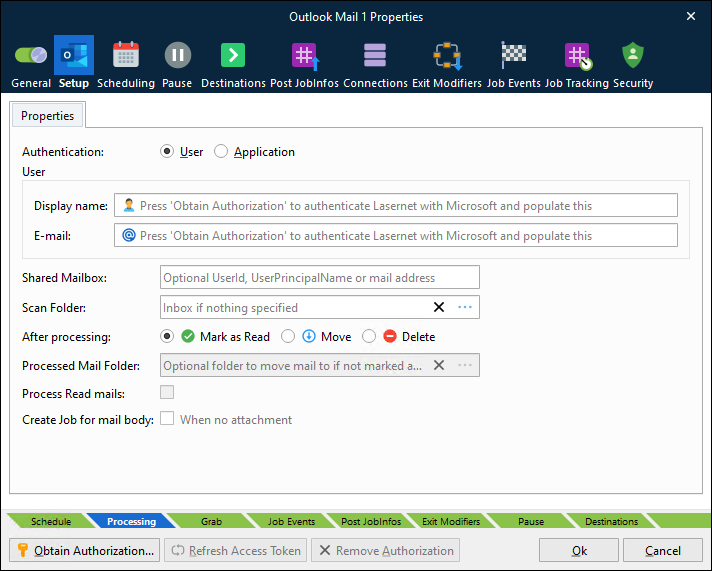
Select Authentication Type
Select which type of authentication the module will use:
User: The module authenticates as a user.
Application: The module authenticates as an application registered in Entra ID.
Authenticate as a User
Set Authentication to User, then click Obtain Authorization to access the account for your organization and to autofill the Display name and E-mail fields.
The Outlook Mail module will obtain authorization to:
Maintain access to data to which you have granted access.
Configure individual permission to send mail on behalf of yourself.
Configure API permission to send mail on behalf of others.
Sign you in and read your profile.
The Remove Authorization button deletes the obtained authorization.
Note
Obtain Authorization and Remove Authorization are available only when you select User authentication.
User Authentication Properties
Display name | Display name for the account (click Obtain Authorization to autofill this field). |
E-mail address for the account (click Obtain Authorization to autofill this field). | |
Shared Mailbox | To use a shared mailbox, insert a UserID, UserPrincipalName or an email address. |
Authenticate as an Application
Authentication as an application for Outlook Mail communication requires that:
Lasernet Core is registered as an app by an Entra ID admin.
In Entra ID, the app has
Mail.ReadWriteandMail.Sendpermissions.The Entra ID admin must provide a ClientID and Client Secret for the module to use to sign in.
Set Authentication to Application, enter Client ID and Client secret (and any other necessary settings), then click Refresh Access Token.
Note
If the client ID and client secret change in the future, repeat the step above and then commit and deploy the Lasernet Core configuration. Doing this ensures that the module remains authenticated.
At any time, you can click Refresh Access Token to test that the currently provided credentials are valid. When you click the button, Lasernet Developer attempts to use those credentials to obtain a new access token.
Application Authentication Properties
Tenant Domain | Enter the relevant tenant domain. |
Client ID | The Entra ID admin must provide a client ID for the module to use for authentication. |
Client Secret | The Entra ID admin must provide a client secret for the module to use for authentication. |
Mailbox | Specify the mailbox to access (as a UserId, UserPrincipalName, or mail address) |
Refresh Access Token
If Lasernet Core experiences issues connecting to Outlook Mail, there might be a problem with its current security tokens. In some cases, the Refresh Access Token button can resolve connection issues.
Connection issues can occur for a number of reasons, including:
More than 90 days of inactivity (user authentication).
The user changed their password (user authentication).
Permission or security changes to the user (user authentication).
Revocation of permissions (user authentication or application authentication).
If Lasernet Core experiences connection issues, try the following steps (depending on the authentication method used).
User Authentication
Click Refresh Access Token to obtain new tokens, then commit and deploy the Lasernet Core configuration.
If doing this does not resolve the issue, click Remove Authorization to remove the currently stored security tokens, then click Obtain Authorization to reauthenticate using the user account (which will also refresh the security tokens). Then, commit and deploy the Lasernet Core configuration.
Application Authentication
Click Refresh Access Token to obtain new tokens, then commit and deploy the Lasernet Core configuration.
Other Module Properties
Scan Folder | Folder where emails are read from. If scanning a subfolder of the Inbox, the syntax is Inbox\Test |
After processing | Specifies what happens to an email after this module processes it:
|
Processed Mail Folder | Specify a folder for mails set to move after processing. |
Process Read Mails | Activate to process incoming mails that are marked as read. |
Create Job for mail body | Activate to create a job from the email body, if no attachment available. |
JobInfos
When a mail is received, a job is created for each attachment – JobData is set to the attachment. The following JobInfos are set:
InputAttachmentCount | Total number of attachments included in the incoming email. |
InputAttachmentNumber | Handling attachment number for the incoming email. |
InputBody | The body of the mail. |
InputFilename | The filename of the attachment. |
InputFromEmail | The email address of the sender. |
InputFromName | The display name of the sender. |
InputHeaderFieldName and InputHeaderFieldValue | A pair of JobInfo lists that contain the names and values of the custom mail headers received by this module. Each header’s name is an item in InputHeaderFieldName. That header’s value is the corresponding item in InputHeaderFieldValue. For example, if InputHeaderFieldName[5] = X-MS-Has-Attach, the value of the X-MS-Has-Attach mail header (in this example, Yes) is in InputHeaderFieldValue[5]. |
InputMessageID | Unique identifier for the incoming mail. |
InputMimeType | The mimetype of the attachment. |
InputReplyTo | The ‘reply to’ address of the sender for the incoming email. |
InputSubject | The subject of the mail. |